
How to Compare Bookkeeping Service Prices in Sydney
Bookkeeping service pricing makes sense only when the quote defines the work, transaction volume, reporting cadence, payroll activity, cleanup needs, software and tax coordination. A monthly figure without those details cannot show whether two providers are offering the same service.
This local guide is designed for businesses in Sydney, Parramatta and Liverpool that need to turn a broad monthly figure into a comparable scope. The public AATBS package figures below were reviewed on 17 July 2026 and should be confirmed on the live homepage before a decision.

Start with the current public package context
The AATBS homepage currently presents three monthly package reference points and says the right package is confirmed after the first conversation:
| Public package | Current homepage figure | Homepage positioning |
|---|---|---|
| Thinker | $220 per month | Small businesses that need tax and annual accounts |
| Mover | $550 per month | Businesses that need BAS and regular reports |
| Shaker | $1,100 per month | Businesses that need more regular planning |
These are current business-package reference points, not a universal price list for every bookkeeping file. The homepage also says AATBS confirms the work, timing and price before anything starts. A bookkeeping quote should therefore identify which package or custom scope applies and what is included.
Separate ongoing work from catch-up work
Ongoing bookkeeping maintains a file from an agreed starting point and cadence. Catch-up or cleanup work addresses older unreconciled transactions, missing documents, duplicated entries, incorrect coding, payroll differences or incomplete prior periods. Combining both under one monthly label hides the initial workload.
Ask the quote to separate:
- initial file review and setup;
- historical cleanup and the period covered;
- software migration or chart-of-accounts work;
- recurring weekly or monthly bookkeeping;
- quarterly and year-end coordination;
- advisory or reporting outside routine processing.
A clean file with established bank feeds is not the same project as a file with several incomplete periods. The quote should make that difference visible.
Count workload drivers instead of guessing hours
Transaction count is one driver, but it is not the whole workload. A smaller number of complex transactions can require more review than a larger, consistent feed. Ask how the provider assesses bank and card accounts, sales channels, supplier bills, loans, asset purchases, foreign transactions, owner transactions and manual journals.
Document quality also matters. Consistent digital receipts, clear approval rules and timely responses reduce investigation. Missing source documents and unclear personal-versus-business items create queries that neither automation nor a headline package can remove.
Define the bookkeeping cadence
| Cadence | Typical decision question | Scope detail to confirm |
|---|---|---|
| Weekly | Do owners need current cash, receivable and payable information? | Accounts reviewed, cut-off day and query response |
| Monthly | When is the period considered closed? | Reconciliations, review, adjustments and report date |
| Quarterly | How is BAS information prepared and reviewed? | GST coding, supporting records, approval and lodgment role |
| Year-end | What is handed to the accountant? | Workpapers, reconciliations, open items and final adjustments |
A lower-frequency package may suit a simple file, but it should not be compared as though it includes the same current reporting as weekly work. Agree on when queries are raised and how late documents affect the close.
List the accounts and systems in scope
Record every bank account, credit card, payment processor, loan, point-of-sale platform, online store, expense tool and payroll system. Identify which systems connect automatically and which require imports or manual review.
Confirm whether the provider configures software, maintains bank rules, manages user access, supports integrations and monitors failed feeds. Software subscription costs should be shown separately when they are not included in the service package.
Clarify payroll and Single Touch Payroll work
Payroll can change the scope through employee count, pay frequency, awards or agreements, allowances, leave, super information, terminations and corrections. The Australian Taxation Office's Single Touch Payroll guidance explains that STP is the process for reporting employee payroll information to the ATO and provides current reporting options and employer guidance.
A quote should distinguish payroll processing from payroll bookkeeping, STP reporting, employee changes and advisory questions. Ask who approves each pay run, who submits information and how corrections are handled.
Define BAS and record-keeping responsibilities
The ATO's current small-business material says business records support activity statements, annual tax returns and other tax obligations. Bookkeeping scope should identify who collects records, codes GST, resolves unclear items, prepares the file, reviews the activity statement and completes lodgment.
Use the ATO business record-keeping guide to understand the categories of income, expense and year-end records a business may need. Then obtain advice for the entity's circumstances. A bookkeeping package should not blur routine processing and tax advice.
Choose the reporting outputs
Basic bookkeeping may end with reconciled records. A broader package may include a profit and loss statement, balance sheet, cash summary, receivables, payables, management commentary or a planning meeting. List the exact reports, delivery date, comparison period and review included.
Ask whether the figures are cash or accrual based, whether the month is formally closed, and which outstanding questions remain. A polished dashboard is less useful if key accounts have not been reconciled.
Set the query and approval workflow
Every file creates questions. Decide where they are sent, who answers, the expected response rhythm and what happens when an item remains unresolved. A shared query report can prevent important issues from being buried in several email threads.
List the decisions that require owner approval: new supplier details, unusual payments, payroll changes, journals, BAS figures and scope changes. Strong bookkeeping is not only data entry; it is a controlled handoff between the business and provider.
Account for industry and entity complexity
Construction, retail, professional services, medical practices, property activity and online sales can create different document and system patterns. Multiple entities, trusts, loans between entities, inventory, projects or locations can also change the work.
Do not assume a package covers every connected entity. Ask for a list of included entities, accounts and reporting obligations. If specialist tax or legal advice may be needed, the quote should show the referral or coordination path.
Compare fixed, tiered and custom pricing
A fixed package can create predictable billing when the scope and assumptions are clear. A tiered package can match growing transaction or service levels. Custom pricing can fit unusual files but needs an equally clear definition and change process.
For any model, ask:
- what triggers movement to another tier;
- which work is outside the recurring package;
- how additional work is approved;
- whether software is included;
- when pricing is reviewed;
- what happens during unusually busy periods;
- how the engagement can be changed or ended.
Use a quote request that providers can answer
Send the same facts to each provider. Include the entity type, industry, current software, financial year, accounts, approximate monthly transactions, sales channels, payroll size and frequency, BAS cycle, cleanup status, desired close date and reports. Identify current deadlines and who will supply documents.
Attach only information through a secure, approved process. A first conversation can establish scope without emailing sensitive records to an unverified address.
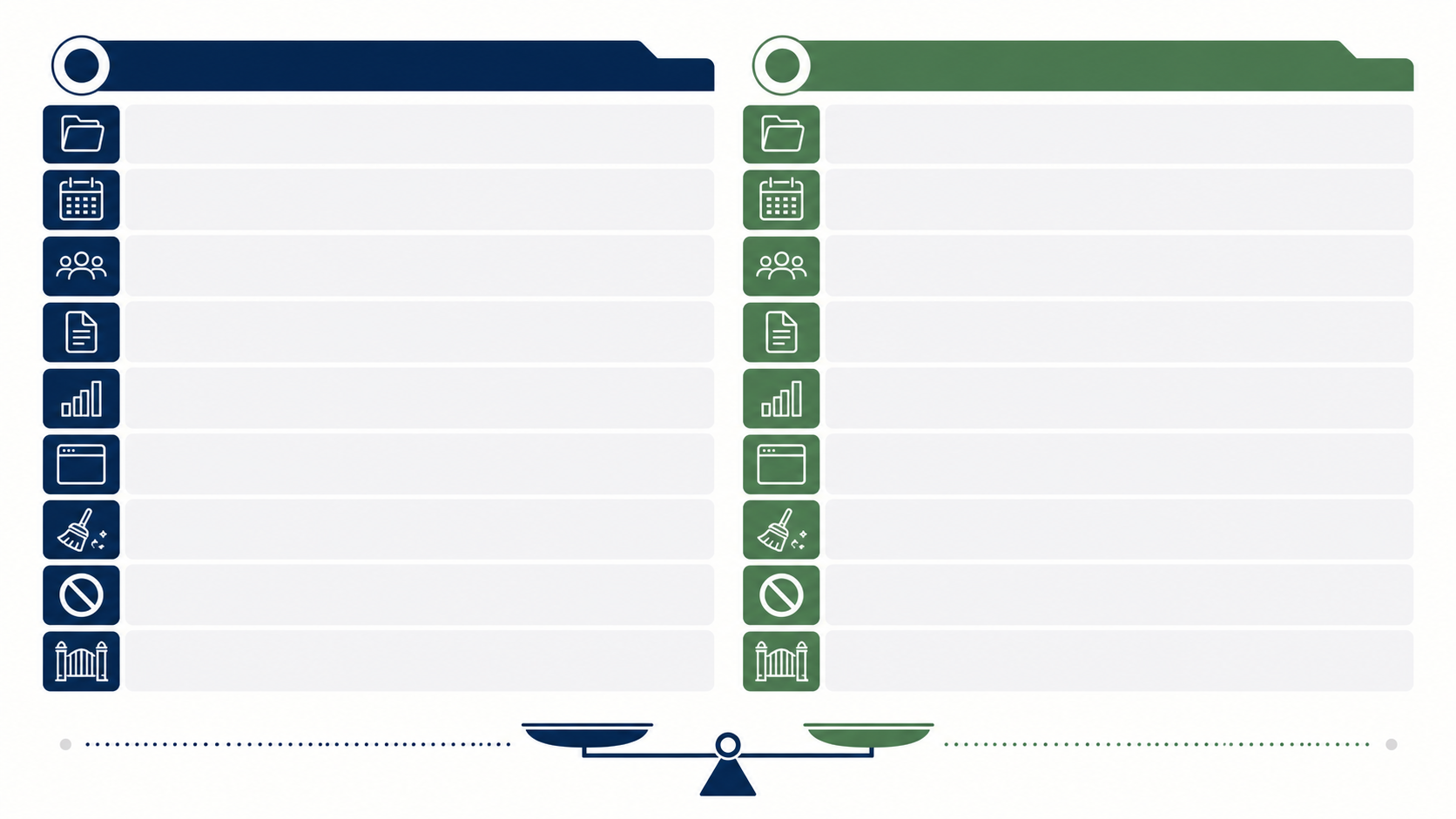
Build an apples-to-apples quote table
| Comparison item | Provider A | Provider B | Question |
|---|---|---|---|
| Initial review and cleanup | Included or separate | Included or separate | Which period and issues? |
| Recurring bookkeeping | Cadence and accounts | Cadence and accounts | When is the month closed? |
| Payroll and STP | Included tasks | Included tasks | Who approves and submits? |
| BAS support | Preparation and review | Preparation and review | Who lodges? |
| Reporting | Outputs and timing | Outputs and timing | Is commentary included? |
| Software | Included or additional | Included or additional | Which subscriptions? |
| Out-of-scope work | Approval method | Approval method | How is it priced? |
Do not award the work until the unanswered cells are resolved. A cheaper total with missing payroll, BAS or cleanup work may cost more after additions.
Review provider fit as well as price
Ask who will work on the file, who reviews it, how continuity is handled and how quickly critical issues are escalated. Confirm experience with the business's software and workflows. Request a clear onboarding list and first-close timetable.
Communication fit matters. Some owners want a monthly meeting; others need a concise query list and scheduled review. Pay for the cadence the business will actually use rather than features that will be ignored.
Red flags to avoid in a bookkeeping quote
- A monthly price with no included accounts, entities or cadence
- Cleanup described as unlimited without a reviewed starting point
- Payroll, STP and BAS blended without named responsibilities
- No process for additional work or scope changes
- Reports promised without a reconciliation and close definition
- Software and subscriptions left unclear
- No secure document or access process
- Tax or legal conclusions offered without the appropriate engagement
Frequently asked questions
How much do bookkeeping services cost?
The price depends on the file and service scope. AATBS currently shows monthly business-package reference points of $220, $550 and $1,100 on its homepage, with final work, timing and price confirmed after a conversation. Ask which bookkeeping tasks each option includes for your file.
Is monthly pricing better than hourly pricing?
Neither is automatically better. Monthly pricing can improve predictability when scope and change triggers are clear. Hourly or project pricing may fit uncertain cleanup work. Compare the actual deliverables and approval process.
Why does cleanup cost extra?
Historical work can involve missing documents, unreconciled accounts, coding corrections and earlier payroll or BAS questions. It should be assessed and separated from ongoing maintenance.
Should payroll be part of bookkeeping?
It can be, but the quote should name payroll processing, STP reporting, approvals, employee changes and corrections separately so responsibilities are clear.
What should I bring to a first consultation?
Bring a system and account list, transaction estimate, payroll facts, BAS cycle, current deadlines, cleanup history, reporting needs and the outcomes you want from the monthly close.
Contact AATBS after defining the local bookkeeping scope
A useful bookkeeping price follows a defined operating rhythm. Count the systems, accounts, transactions, payroll activity, reporting outputs, cleanup and advisory needs first. Then choose the package or custom scope that covers them with a clear owner and deadline.
Review AATBS's live monthly package information and its online bookkeeping guide together.
Authoritative sources reviewed
- AATBS homepage — current public package context and quote process reviewed 17 July 2026.
- Australian Taxation Office business record-keeping guidance — record categories that influence bookkeeping scope.
- Australian Taxation Office Single Touch Payroll guidance — employer payroll reporting context.