
Depreciation in accounting is the systematic allocation of a tangible asset’s cost over its useful life. It matches expense to revenue, clarifies profit, and supports tax compliance. From our Parramatta base at Level 14, we help SMEs pick methods, build asset registers, and automate journals so statements stay consistent and audit-ready.
By Abby Raweri — Advanced Accounting Taxation & Business Services
Last updated: 2026-06-21
Hero Section: Smarter Depreciation, Better Decisions
Use depreciation to convert large purchases into steady, compliant expenses. The right method smooths earnings, improves ratios, and strengthens cash planning. We implement fixed asset policies and monthly runs so your numbers are reliable, comparable, and easy for lenders, boards, and auditors to trust.
We’re a Sydney-based accounting and advisory team supporting businesses across NSW. Our cloud-first approach integrates Xero, MYOB, and QuickBooks, so depreciation schedules post automatically and tie back to your general ledger without manual rework.
Introduction: What Depreciation Means for Your Business
Depreciation measures how much of an asset’s value you use each period. It isn’t cash leaving the business; it’s a non-cash expense that reflects wear, obsolescence, and time. A clear policy prevents overstated profits and keeps financial statements consistent from month to month.
Why this matters: banks and investors read your margins, not just your bank balance. Accurate, periodic depreciation helps you compare performance, set budgets, and avoid year-end surprises. In our experience, monthly runs reduce year-end adjustments and deliver cleaner audit outcomes.
Quick Summary
Choose the method that mirrors how your asset creates value, document it in policy, post monthly entries from a fixed asset register, and reconcile to your GL. Review useful lives annually and adjust when facts change or impairment indicators appear.
- Prime cost (straight-line) suits assets that deliver value evenly across periods.
- Diminishing value accelerates expense where early benefits are larger.
- Units-of-production ties expense to mileage, hours, or output.
- Leasehold improvements usually align with the lease term (plus renewals that are reasonably certain).
- Document lives, residuals, and methods by asset class; disclose changes promptly.
Services Offered: End-to-End Fixed Asset Support
We design and run your depreciation process from policy to posting. That includes capitalization rules, register build and cleanup, method selection, monthly journals, reconciliations, tax versus book schedules, and audit-ready documentation—all integrated with your cloud ledger.
Advanced Accounting Taxation & Business Services (AATBS) delivers a coordinated, compliance-first approach. Because we also manage bookkeeping, BAS, payroll (STP), year-end reporting, and assurance, you get one partner from setup through audit.
- Asset capitalization policy: Thresholds, classes, useful lives, and residual values with approvals and documentation.
- Register build & cleanup: Migrate spreadsheets into Xero, MYOB, or QuickBooks; deduplicate assets; attach invoices and serials.
- Method selection: Straight-line, diminishing value, or units-of-production aligned to economic use.
- Monthly depreciation runs: Automated journals, roll-forwards, and GL tie-outs.
- Impairment and disposals: Trigger-based reviews; process write-downs, sales, and gains/losses correctly.
- Tax vs. book schedules: Maintain parallel schedules where tax rules differ from financial reporting.
- Audit-ready pack: Policy memos, assumptions, and evidence for external review.
Exploring broader support? See our accounting services overview for Sydney and our guide to bookkeeping services to understand how depreciation links with day‑to‑day recordkeeping.
How Depreciation Works (Methods and Examples)
Pick the method that best reflects how the asset earns its keep. Straight-line spreads expense evenly; diminishing value front-loads it; units-of-production tracks usage. Consistency and disclosure matter more than short-term optics or one-off profit smoothing.
Three methods cover nearly all small and midsize businesses. Below are definitions with simple, numeric illustrations you can adapt to your own register and policies.
Straight-line (Prime Cost)
- What it is: The same expense every period—best when assets deliver value evenly.
- Formula: (Cost − Residual) ÷ Useful life.
- Example: A $12,000 server, 4-year life, $0 residual → $3,000 per year (about $250 per month).
Diminishing Value (Declining Balance)
- What it is: Higher expense early, lower later—mirrors faster initial wear or obsolescence.
- Formula: Opening carrying amount × rate (for instance, 30%).
- Example: $20,000 machine at 30% → Year 1: $6,000; Year 2: $4,200; Year 3: $2,940 (rounded).
Units-of-Production
- What it is: Expense tied to production, hours, or miles.
- Formula: (Cost − Residual) ÷ total expected units × units this period.
- Example: Van cost $45,000, residual $5,000, 150,000-mile life → rate $0.266/mile. If you drive 18,000 miles, expense is about $4,800.
In our experience, posting monthly rather than annually improves trend analysis and covenant monitoring. It also reduces year-end backlog when auditors request roll-forward schedules and supporting documents.
The Process: From Policy to Posting
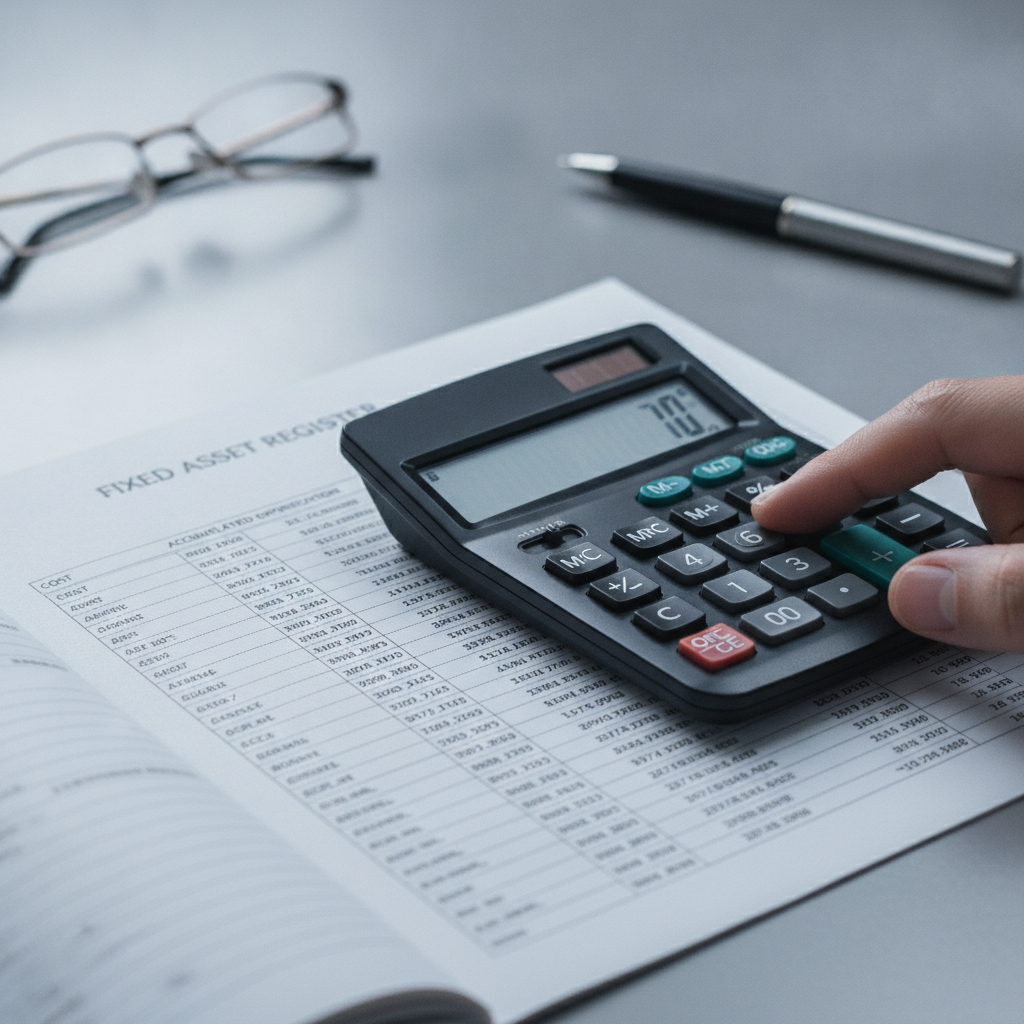
Depreciation is a repeatable workflow: define policy, capture purchases, post monthly entries, review useful lives, and reconcile. We operationalize each step in your cloud ledger so the numbers remain accurate without heavy admin.
- Set policy: Capitalization threshold, classes, useful lives, residuals, and methods approved by management.
- Build the register: Record cost, date, serial number, location, documents, and GL mapping.
- Automate schedules: Configure monthly journals in Xero, MYOB, or QuickBooks with audit trails.
- Monitor changes: Track upgrades, impairments, and disposals with evidence and approvals.
- Reconcile & report: Subledger to GL reconciliations, roll-forwards, and disclosures.
| Stage | Owner | Main Output | Review Cycle |
|---|---|---|---|
| Policy | Management + AATBS | Approved policy memo | Annual |
| Register | AATBS | Clean, complete asset file | Ongoing |
| Posting | AATBS | Monthly journals + GL tie-out | Monthly |
| Review | Management | Updated lives/methods | Annual/triggered |
| Audit | AATBS + Auditor | Disclosure & support pack | Year-end |
Want your finance stack to hum? Our cloud accounting implementation guide outlines the integrations we configure so depreciation journals flow automatically and tie out every month.
Pricing: How We Scope Depreciation Support
Engagements are tailored to your asset volume, software, reporting needs, and audit requirements. We agree scope up front, then deliver on a predictable cadence with clear inclusions—no surprises, just a clean process that keeps your books accurate.
- Fixed-asset policy drafting or refresh.
- One-time register build or cleanup project.
- Ongoing monthly depreciation runs and reconciliations.
- Parallel tax and book schedules with year-end disclosures.
- Audit support and external-review coordination.
For a broader picture of ongoing support, explore small business accounting best practices and our business advisory services explainer.
Why Choose AATBS for Depreciation and Fixed Assets
We combine 20+ years of experience, cloud-first workflows, and assurance know-how. The result: faster close cycles, fewer audit adjustments, and clearer performance trends for owners, lenders, and boards.
- Cloud-native automation: Xero, MYOB, and QuickBooks schedules tuned for monthly journals and audit trails.
- Compliance-first: We manage BAS, payroll (STP), PAYG, and superannuation—so your asset policy aligns with the whole compliance picture.
- End-to-end delivery: From capitalization policies to audit packs under one roof.
- Local expertise: Western Sydney roots with clients across NSW and beyond.
- Concierge CFO: Board-ready reporting, capex modeling, and replacement planning when you need deeper insight.
New to running a finance function? Our startup accounting essentials article shows how a light, automated register can save hours every month.
Choosing a Method: Quick Comparison
Match the method to how value is consumed: even usage suggests straight-line; front-loaded benefits favor diminishing value; variable output points to units-of-production. Consistency and clear disclosure build trust and comparability.
| Method | Best For | Pros | Watch-outs |
|---|---|---|---|
| Straight-line | IT gear, office fit-outs | Stable margins; easy to explain | May lag real-world wear |
| Diminishing value | Vehicles, machinery | Reflects early obsolescence | More volatile profits |
| Units-of-production | Fleet, manufacturing lines | Tight link to usage | Needs reliable usage data |
Technology helps. This asset management software overview highlights how modern tools support lifecycle tracking—useful when you’re collecting hours, miles, or output for units-of-production methods.

Service Area: Parramatta, Liverpool, and Across NSW
We support businesses in Parramatta, Liverpool, and across New South Wales. Remote delivery keeps month-end fast, and we offer on-site visits for inventory counts, asset tagging, and auditor walkthroughs when required.
Whether you’re centralizing finance in Western Sydney or coordinating multiple sites, we design asset processes that scale with growth and keep your ledgers tidy month after month.
Local considerations for Parramatta
- Schedule asset counts close to quarter-end so capex and disposals flow into group reporting without delay.
- Plan year-end reviews ahead of holiday periods to avoid staffing bottlenecks and rushed impairment testing.
- For construction and trade fleets, keep mileage and hours logs current—usage data underpins units-of-production accuracy.
If you’re building a finance calendar, these examples of a yearly cycle table and a monthly cycle structure can inspire how you visualize recurring tasks and checkpoints.
Testimonials
Clients value clear policies, cleaner audits, and steadier margins. Here’s what business owners say after we formalize depreciation and asset management across their ledgers.
- “Our monthly reports finally make sense. The asset register cleanup paid off in a smoother audit.” — Construction company owner, Parramatta
- “We moved to monthly depreciation in Xero and cut our year-end adjustments dramatically.” — Retail operator, Western Sydney
- “Their CFO-style guidance helped us pick methods that match how our equipment actually earns.” — Manufacturing director, NSW
Frequently Asked Questions
These short answers address the most common depreciation questions we hear from owners and finance managers. They’re concise, practical, and ready to apply today.
What is depreciation in accounting?
It’s the systematic allocation of a tangible asset’s cost over its useful life. You expense a portion each period to reflect wear and time, improving profit accuracy and supporting compliance.
Which depreciation method should I use?
Use the method that mirrors value consumption: straight-line for even use, diminishing value for front-loaded benefits, and units-of-production when usage varies. Keep your choice consistent and documented in policy.
How often should I post depreciation?
Monthly postings improve margin analysis, lender reporting, and cash planning. They also reduce large catch-up adjustments at year-end and make audits smoother.
What records should my asset register include?
Store cost, purchase date, serial number, location, class, method, useful life, residual value, and documents (invoice, warranty). Track impairments, upgrades, and disposals with dates and approvals.
Key Takeaways
A solid depreciation process aligns policy, data capture, automation, and review. When each step is tight, monthly results are clearer, financing gets easier, and year-end is more predictable—freeing you to focus on growth, not reconciliations.
- Pick a method that reflects how assets create value and apply it consistently.
- Automate monthly journals in your cloud ledger and reconcile to the GL.
- Keep complete asset records—cost, serials, documents, and locations.
- Review useful lives yearly and watch for impairment indicators.
- Maintain tax-versus-book schedules where rules differ from reporting.
Final CTA: Get Your Depreciation Process Right
If your asset register still lives in a spreadsheet or your monthly numbers swing, it’s time to formalize depreciation. We’ll design policy, automate postings, and keep audits smooth—so you can focus on growth.
Book a free consultation to review your asset policy, register, and software setup. We’ll map quick wins and a simple three-step rollout: Consultation → Choose a Package → Get Your Service.