
An Australian adviser-selection comparison
Compare Taxation Consultants by Scope and Accountability
Short answer. Compare taxation consultants by the work you need, not by a broad promise to “handle tax”. First verify the relevant practitioner and any conditions on the Tax Practitioners Board register. Then compare the exact scope, responsible adviser, information required, written deliverables, pricing basis, review process, data handling and escalation path. A one-off return, recurring BAS support, proactive advisory project and specialist matter are different engagements.
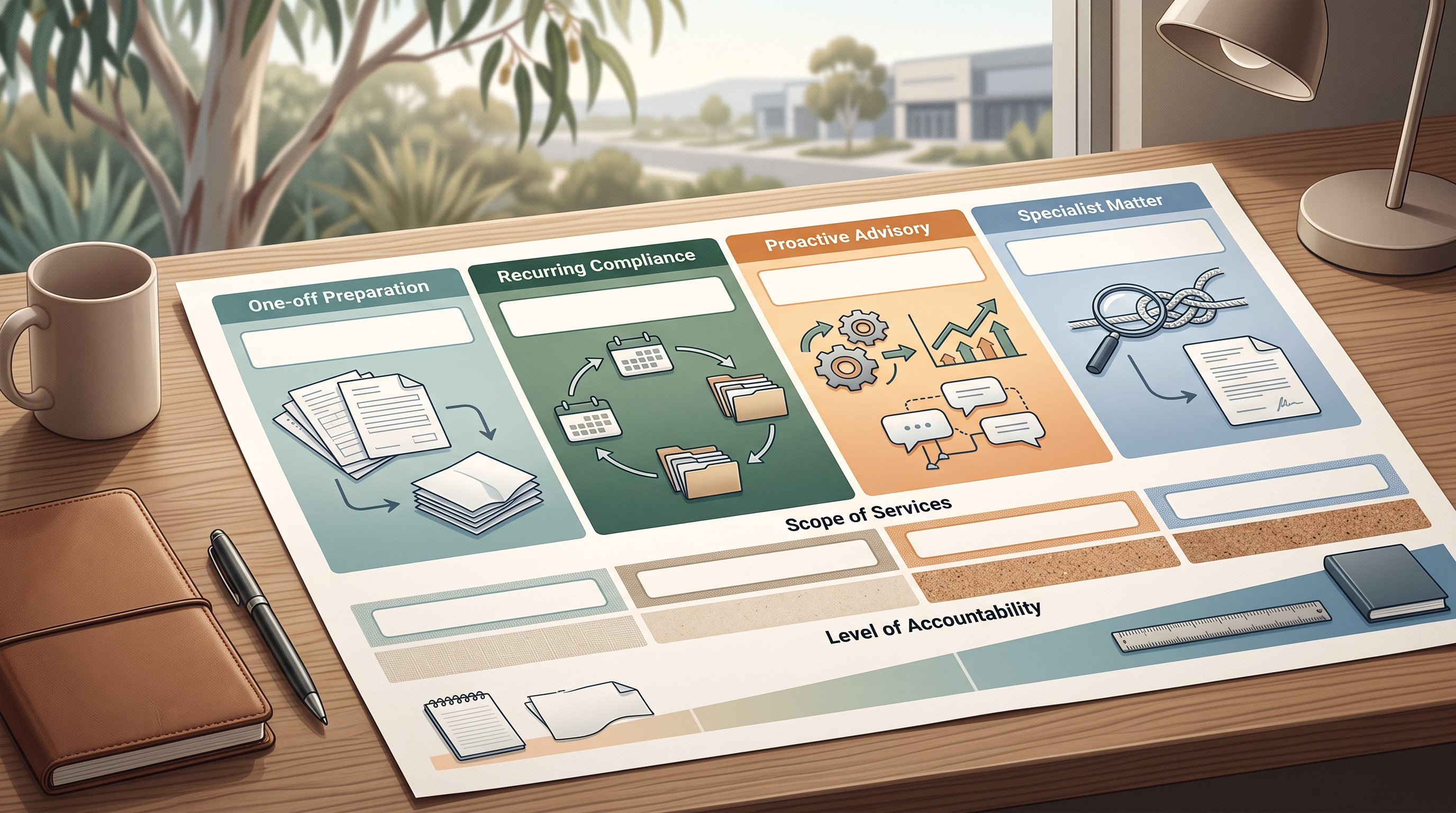
A fair comparison starts with the same facts, the same requested deliverables and a named person accountable for each stage.
Define the tax decision before comparing consultants
Start with the event or obligation, entities involved, time period, current records, unresolved notices, due dates and decisions you expect to make. Separate preparation and lodgment from advice. Preparing an annual return, keeping recurring records, modelling a transaction and resolving a specialist issue call for different inputs and expertise.
Write what a successful engagement would deliver without stating a desired tax outcome. A useful objective could be “confirm the information needed, prepare the agreed return, identify assumptions and explain the final position”. “Get the largest refund” or “guarantee no tax” is not a sound selection brief.
AdvancedTax publishes pages on accounting, BAS returns and business advisory. Those pages show topics to discuss; they do not establish the scope, registration, price or suitability of a particular engagement.
Compare four taxation consultant service models
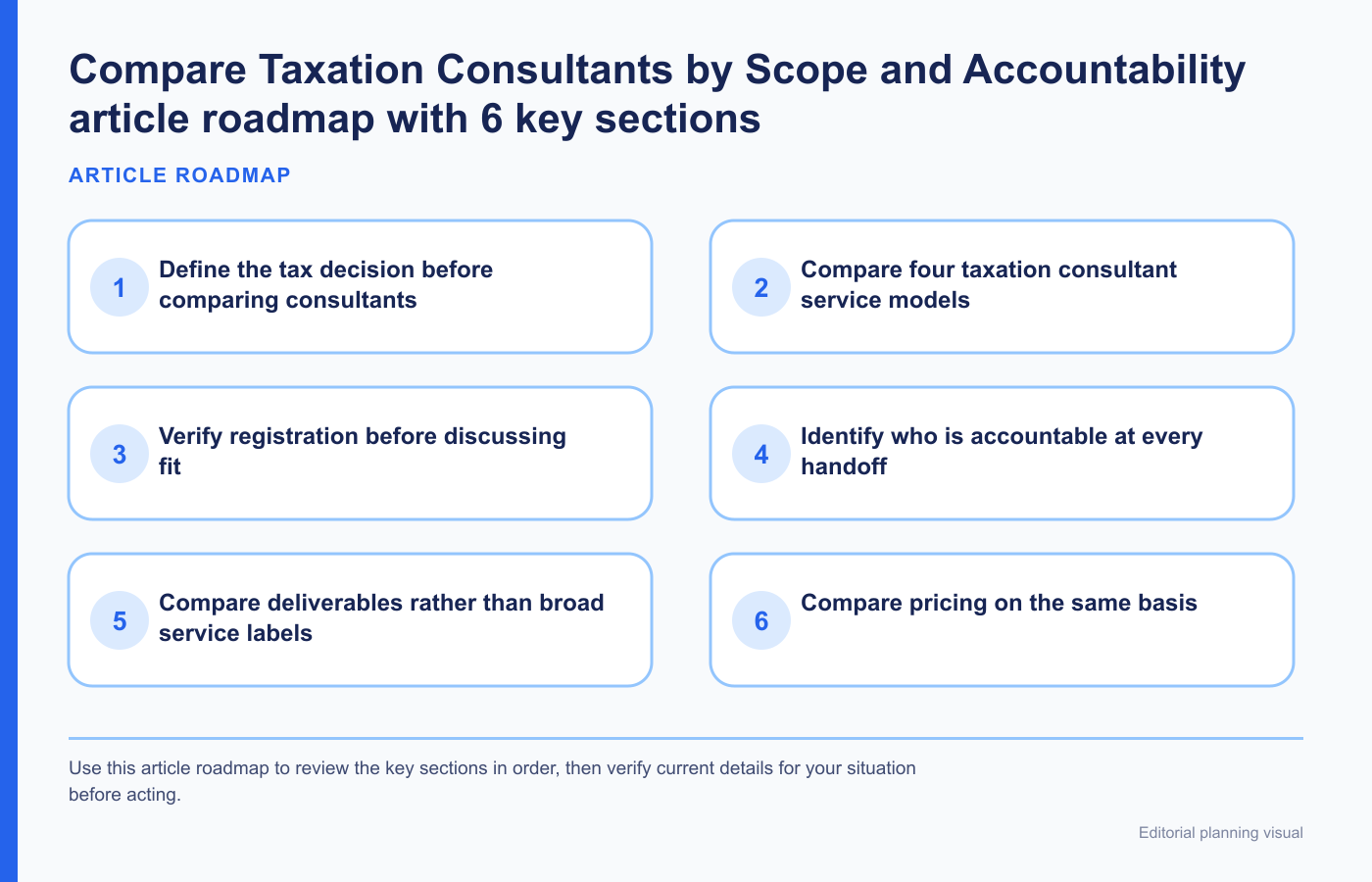
Use this article roadmap to review the key sections in order, then verify current details for your situation before acting.
| Model | Potential fit | Main trade-off to examine | Evidence to request |
|---|---|---|---|
| One-off preparation | A defined return or lodgment with organised records | Efficient scope may exclude planning, cleanup or ongoing support | Included forms, review, assumptions and lodgment responsibility |
| Recurring compliance | Businesses needing regular bookkeeping, payroll, BAS or year-end coordination | Continuity helps only when responsibilities and cut-offs are clear | Calendar, handoffs, reconciliations, exception process and reporting |
| Proactive advisory | A decision requiring scenarios, assumptions and follow-through | Advice may be wasted when records are unreliable or implementation is outside scope | Question, scenarios, sources, recommendation boundary and implementation owner |
| Specialist matter | SMSF, transaction, dispute, residency or other complex issue | A generalist may coordinate but not perform every specialist task | Relevant competence, external specialists, conflicts and signed boundaries |
Some engagements combine models. If so, ask the consultant to separate each workstream, responsible person, deliverable and fee basis.
Verify registration before discussing fit
The TPB Public Register lets consumers check tax and BAS agent registration, conditions and certain public sanctions. Search the legal or registration name and number rather than relying on a logo, advertisement or job title. Record the result and review any condition that could limit the services offered.
The TPB's guidance on finding and using a tax practitioner explains that registered tax agents and BAS agents have different service scopes. Ask which registered entity is engaged and which registered individual is responsible for the work. Verification should be current at appointment.
This article does not verify AdvancedTax or any individual registration. Perform the official search and ask the firm to connect the register entry to the engagement letter.
Identify who is accountable at every handoff
The person who sells the service may not prepare, review or lodge the work. Ask who receives documents, who asks follow-up questions, who performs the work, who reviews it, who communicates the final position and who is available after lodgment. If work is outsourced or supported by software, ask how review and privacy responsibilities remain controlled.
- Name the legal client and every entity in scope.
- Name the practitioner or team responsible for each deliverable.
- Record who may make elections, approve assumptions and lodge.
- Define response and escalation channels without assuming a guaranteed time.
- State what remains the client's responsibility.
For some businesses, appointing a new registered agent also involves client-to-agent linking. The ATO publishes agent nomination instructions; check whether they apply to your entity and account.
Compare deliverables rather than broad service labels
Request an engagement letter or written scope. It should identify the period and entities, services included, exclusions, information the client must provide, assumptions, due dates, review steps, deliverables, lodgment authority, records retained, fees and termination process. Ask how a late document, prior-year problem or new transaction changes the work.
For advisory work, require the question and assumptions to be explicit. Ask whether the output is a meeting, calculation, written advice, implementation plan or referral. Determine who monitors later changes in facts or law. Advice based on one scenario should not be treated as a continuing guarantee.
AdvancedTax also publishes topic pages for SMSF and tax-related planning. Use them to identify questions, then verify the responsible practitioner's current scope and the precise deliverable.
Compare pricing on the same basis
A fixed fee, hourly rate, monthly package and project quote are not directly comparable until inclusions are aligned. Give each consultant the same facts and ask what triggers extra work. Separate recurring tasks from cleanup, historical amendments, notices, complex advice, software, specialist referrals and disbursements.
Review the business's published pricing information only as a starting point. Confirm the current price, GST treatment, payment timing, scope, exclusions and change process in writing. A lower headline figure may omit review or support; a larger package may include work you do not need.
Review how records and access will be handled
Tax records can contain sensitive identity, financial and business information. Ask which portal or transfer method is used, who can access the file, how identity is checked, where authorisations are recorded and how access is removed when the engagement ends. Do not email identity documents or credentials merely because it is convenient.
Ask what source records you must retain, what the consultant keeps, how corrections are recorded and how you obtain a complete handover. Good information handling supports accountability; it does not remove the client's obligation to provide accurate information and review declarations.
Use a consistent taxation consultant scorecard
| Criterion | What a decision-ready answer contains |
|---|---|
| Registration | Matching TPB entry, type, status and relevant conditions |
| Scope | Entities, periods, services, exclusions and assumptions |
| People | Named preparation, review, advice and escalation ownership |
| Deliverables | Specific documents, meetings, lodgments or advice outputs |
| Records | Required inputs, retention, corrections and handover |
| Fees | Basis, inclusions, extras, GST and change approval |
| Continuity | Review cadence, changes in facts or law, and ending the engagement |
Taxation consultant selection mistakes to avoid
- Choosing on a promised refund, saving or outcome
- Relying on a job title without checking the TPB Register
- Comparing prices before aligning scope and exclusions
- Assuming the salesperson is the responsible practitioner
- Leaving data transfer and account access undefined
- Treating tax preparation, advisory and specialist work as interchangeable
- Failing to record assumptions, client responsibilities and change approvals
Frequently asked questions
Is a tax agent the same as a BAS agent?
No. Their permitted service scopes differ. Check the TPB Register and ask how the registration matches the work you need.
Should I choose a fixed fee or hourly taxation consultant?
Neither basis is automatically better. Compare the defined scope, uncertainty, extra-work triggers and change approval process.
Can a consultant guarantee a tax saving or refund?
Be cautious of outcome promises. Tax consequences depend on current law, evidence and your facts. Ask for assumptions and boundaries.
What should I bring to an initial discussion?
Bring the entity list, question, relevant periods, deadlines, notices, record summary and desired deliverable. Avoid sending sensitive records before confirming a secure method.
Request a scoped taxation consultation
Prepare a one-page brief and compare it against the models and scorecard above. Use AdvancedTax's contact page to request a discussion about current scope, responsible practitioner, registration, deliverables, fees and information handling. Verify official registration and obtain a written engagement before relying on any advice or lodgment service.
General information only. It is not personal tax, legal, financial or superannuation advice.