Bookkeeping services buyer guide
How to Choose Bookkeeping Services for Your Business
Short answer: Choose bookkeeping services by documenting your transaction volume, accounts, payroll or inventory touchpoints, current backlog, software, deadlines and reporting needs. Ask each provider for a written responsibility matrix, access model, review process, regulated-service boundary, fee basis and exit handover. Verify any tax or BAS practitioner registration independently.
“Keep the books up to date” sounds simple until two people use different definitions of received, reconciled, reviewed and ready. A strong selection process makes those states visible. This guide helps Australian business owners compare bookkeeping support without claiming a specific AdvancedTax package, qualification, fee, tax outcome or service result.

Define what “bookkeeping” means for your business
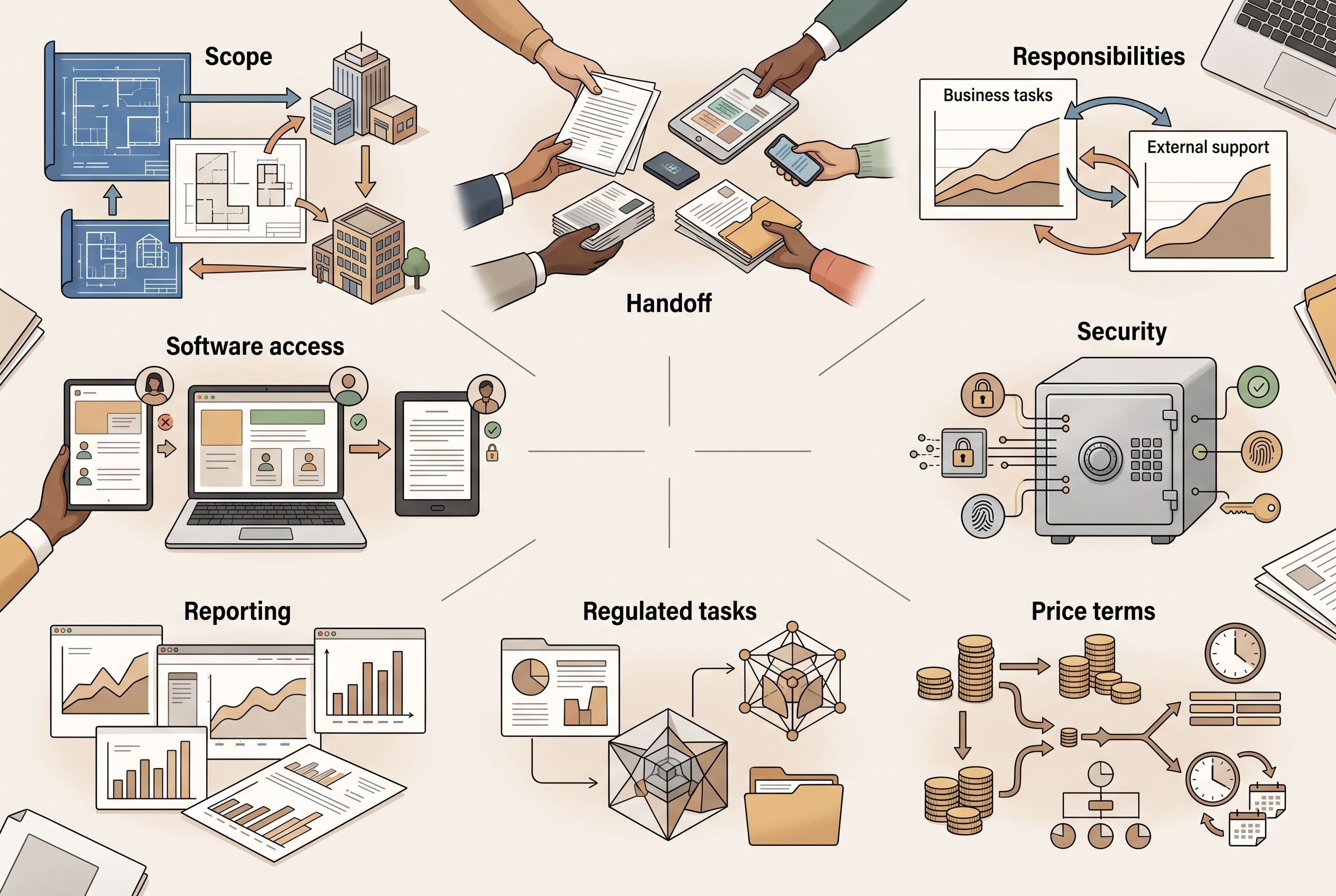
List the bank and card accounts, sales channels, bills, expense claims, loans, assets, payroll touchpoints, inventory systems and inter-entity transactions that may create records. Note approximate monthly volume and any backlog, without sending sensitive data during an initial inquiry. Identify the outputs you expect, such as reconciled accounts, management reports or a clean handoff to an accountant.
Then mark what is explicitly outside the request. Bookkeeping, payroll processing, BAS preparation or lodgement, tax returns, financial advice and business advisory can overlap operationally but are not interchangeable. Ask the provider to state which tasks are included, which require a separately registered practitioner, and which remain with you.
AdvancedTax publishes a dedicated bookkeeping service route and broader accounting information. Use those pages to frame questions, not to infer an engagement’s exact inclusions, assigned practitioner, fee or result.
Map how records enter, change and leave the workflow
Draw the path from source document to reviewed record. Who sends invoices and receipts? Where do they arrive? Who codes them? Who approves unusual items? Who matches bank activity? Who resolves missing documents? When is a period considered complete? If those questions have no owner, a software tool will not solve the process.
The Australian Taxation Office’s record-keeping for business guidance explains the importance of accurate and complete records. Use current ATO material for general obligations and obtain professional advice for your circumstances. This article does not determine what your business must keep or for how long.
Ask how corrections are documented and how supporting records remain connected to entries. A clean audit trail helps reviewers understand what changed, by whom and why. Clarify who monitors incomplete items and how exceptions are escalated before a reporting or lodgement deadline.
Create a responsibility matrix before engagement
For each recurring task, name the person who supplies information, performs the work, reviews it and approves the final action. Include the owner, internal staff, bookkeeper, accountant, payroll provider and software administrator as relevant. One person may hold several roles, but the distinction should remain visible.
Ask whether work is performed by the person you meet, another team member or a subcontractor, and what supervision applies. Do not assume a company-level credential tells you who will access the file. Request the escalation contact when the regular operator is unavailable.
Set a calendar for weekly, monthly, quarterly and annual handoffs. The business should know what must be provided and by when; the provider should explain when work will be processed and when questions will be returned. Avoid an undefined promise such as “send things whenever you can.”
Check the boundary around BAS and tax services
If the engagement includes BAS services, tax-agent services, preparation or lodgement, or tax advice, ask which registered practitioner is responsible and verify the current registration and any conditions. The Tax Practitioners Board’s consumer guidance explains how to check the register and distinguishes services a registered tax agent or BAS agent can provide.
Do not infer AdvancedTax’s current registrations or any individual’s status from this article. Ask for the legal or registration name and number, then search the TPB register yourself. Confirm the exact entity providing the regulated service and how the work is supervised.
A bookkeeper may prepare operational records without being engaged for every regulated task. The scope should say who reviews records before a lodgement, who communicates advice, who approves the submission and who retains the final documents. Obtain advice tailored to your business.
Review software access, privacy and continuity
Ask which systems the provider needs, what permission level is required, how accounts are created and removed, and whether shared logins are prohibited. Use individual accounts and the least access needed for each role. Multi-factor authentication, password management, secure document exchange and access reviews should be discussed in concrete terms.
Clarify where data is stored, whether work occurs outside Australia, who can view the records and how incidents are handled. Do not send bank credentials, identity documents or complete data exports through ordinary email simply because an inquiry has begun. Agree on a secure intake method.
Plan continuity and exit from the start. The business should retain administrative control of core subscriptions, know how to retrieve records and understand the handover format. Ask what happens to access and retained copies when the engagement ends.
Compare fees, review and reporting as one package
Request a written scope with fee basis, assumptions, exclusions and the process for out-of-scope work. A fixed amount may depend on transaction volume or record quality; an hourly arrangement may need approval thresholds. This guide does not confirm AdvancedTax pricing. Review the current pricing route and obtain an engagement-specific proposal.
Ask what reports are produced, how often, who reviews them and how unexplained balances or old items are handled. A report can be delivered on time and still be unusable if accounts are not reconciled or exceptions remain hidden. Define “complete” and “reviewed” in the scope.
Include service communication: normal response channels, urgent issues, scheduled meetings and absence coverage. Ask how service quality is corrected if agreed work is incomplete. Promised tax savings or guaranteed accuracy are not a substitute for controls, review and clear accountability.
Use a bookkeeping provider scorecard
| Criterion | Evidence to request | Decision question |
|---|---|---|
| Scope | Task list, exclusions and volume assumptions | Does it match our actual workflow? |
| Responsibilities | Supply, perform, review and approve matrix | Is every recurring task owned? |
| Regulated work | Practitioner identity and TPB register check | Who is authorised for the exact service? |
| Controls | Reconciliation, exception and review process | How do errors become visible? |
| Security | Access, storage, incident and offboarding plan | Can access be limited and removed? |
| Commercial terms | Fee basis, assumptions and change approval | When can cost or scope change? |
Score evidence, not presentation. A polished proposal with an unclear responsibility or regulated-service boundary should remain unresolved until the provider answers it.
Common bookkeeping selection mistakes
- Requesting “full bookkeeping” without listing accounts, volume and outputs.
- Assuming bookkeeping automatically includes BAS, payroll, tax or advice.
- Failing to verify a practitioner when regulated work is proposed.
- Giving broad software access before agreeing on roles and security.
- Comparing fees without the same scope and record-quality assumptions.
- Ignoring who reviews reconciliations and unresolved items.
- Leaving business knowledge in one person’s inbox or memory.
- Starting without an exit handover and access-removal process.
Frequently asked questions
What information should I prepare for a bookkeeping quote?
Prepare account and system counts, approximate transaction volume, payroll or inventory touchpoints, backlog, reporting needs, deadlines and the tasks you expect. Share samples only through an agreed secure method.
Is a bookkeeper the same as a BAS agent?
Not necessarily. When BAS services are included, verify the responsible practitioner and permitted service through the TPB register.
Should a provider use my existing software?
That depends on fit, access and workflow. Ask what the provider supports, what would change, who owns subscriptions and how data would be migrated. This guide does not confirm AdvancedTax software support.
Can bookkeeping services guarantee tax savings?
No provider should be selected on an unsupported outcome promise. Ask for scope, controls, evidence and advice specific to your circumstances from an appropriately authorised professional.
Prepare a bounded bookkeeping inquiry
Create the one-page scope, responsibility matrix and security questions before contacting providers. AdvancedTax publishes a team route, a payroll and STP route and a contact page. Use them to request an engagement-specific discussion, then confirm assigned practitioners, regulated boundaries, fees, inclusions and availability in writing.
This guide is general business-selection information, not financial, legal, tax, payroll or accounting advice. Verify current registrations and obtain advice for your circumstances.